An AI agent becomes useful to a business when it can complete a clearly defined task, not simply hold a convincing conversation. For a service company, that task might be preparing a booking request. For a sales team, it might be assembling a lead brief from approved information. These are illustrative starting points, not claims of results from a particular client deployment.
Recent engineering work on agents puts increasing attention on the surrounding system. Anthropic’s April 2026 discussion of managed agents separates execution, orchestration, and durable session history. The practical lesson is that the model, the tools it uses, and the record of completed work should not all depend on one fragile process.
Start by drawing the boundary around one workflow. Write down its inputs, the information the agent may access, the action it may propose, and the condition that ends the task. A booking assistant could collect a service category, location, and preferred time, then prepare a request for review. It should not promise technician availability without checking the scheduling system.
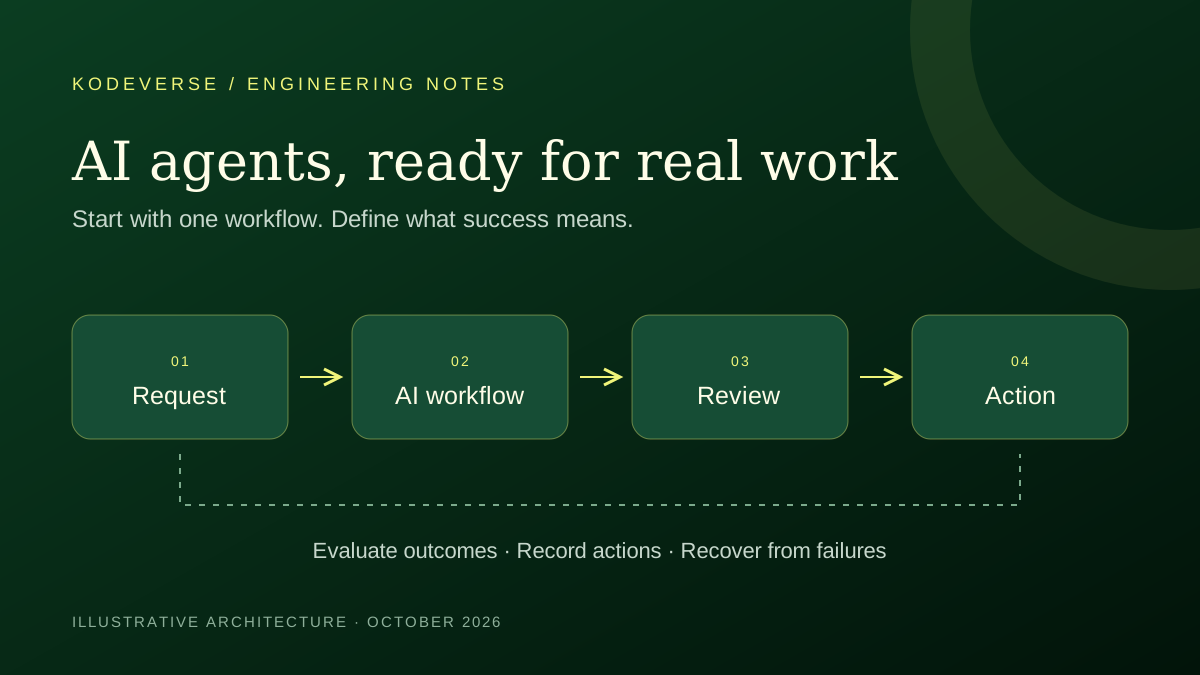
Define success before choosing a larger model or adding more agents. Anthropic’s January 2026 evaluation guide recommends assessing agent behaviour across complete tasks and repeated trials. For the booking example, useful checks include correct service selection, no invented availability, and a clear handoff when an address cannot be validated. A polished response is not enough if the resulting record is wrong.
Measure the whole cost of completing the task. Include model usage, external services, retries, and the time a person spends correcting the result. Compare the pilot with a manual baseline using the same task types. A workflow that finishes quickly but needs frequent repair may provide less value than a simpler assistant that prepares reliable drafts.
Plan for interruptions and duplicate submissions. Save task state outside the running agent, assign each business operation a stable identifier, and confirm whether an action succeeded before retrying it. A timeout after creating a booking should lead to a status check, not an automatic second booking. Give the team a way to inspect the record and take over.
For an initial rollout, a practical approach is to let the assistant prepare work while staff retain control of consequential actions. Expand its responsibility only when evaluation results and operational monitoring support that decision. The first project brief should name the workflow owner, the success measure, the handoff rules, and the systems involved. Those details make an AI proposal easier to scope and its value easier to assess.