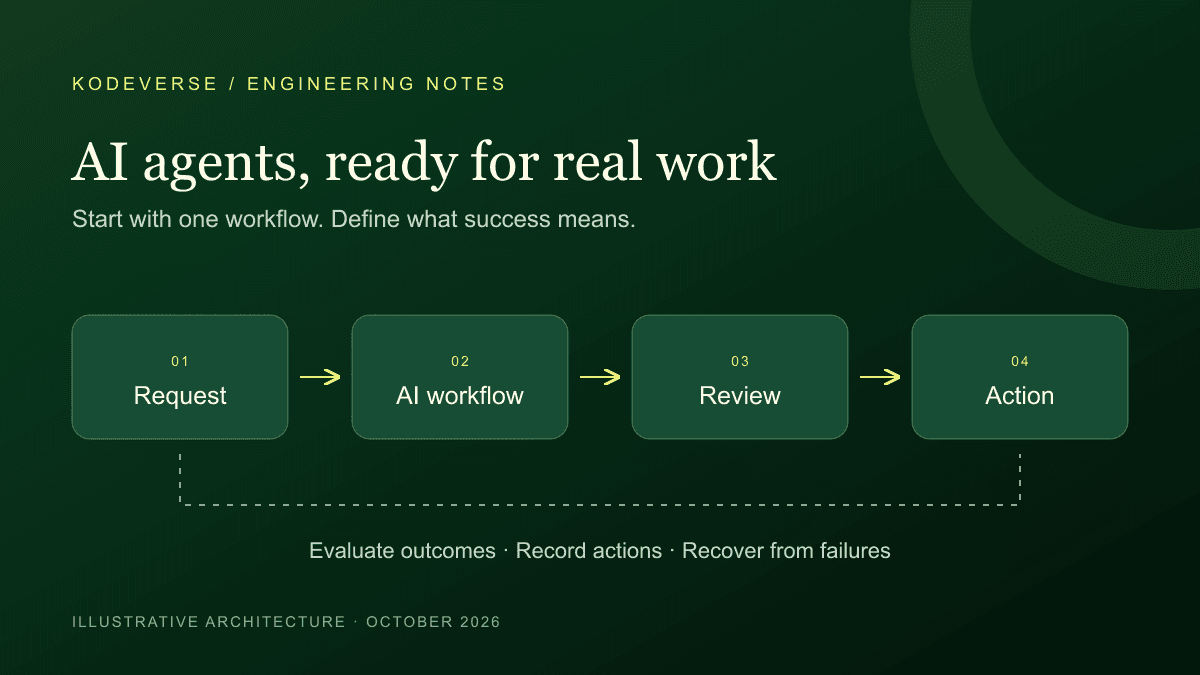
AI agents can take a request, call tools, inspect results, and adjust their next step. That flexibility is useful—but a polished answer in one test is not enough to prove an agent is ready for real users. Production readiness comes from measuring the whole workflow, limiting what it can do, and making failures visible and recoverable.
This guide lays out a practical approach for teams moving an AI agent from prototype to production.
WHY AGENTS NEED WORKFLOW-LEVEL EVALUATION
A traditional model test can compare one input with one expected answer. An agent run may involve several model decisions, tool calls, changing application state, and a final action. A failure can happen at any point: choosing the wrong tool, sending incomplete arguments, misreading a tool response, retrying too many times, or taking an action that should have required approval.
Anthropic’s January 2026 guide to agent evaluations emphasizes testing trajectories and behaviors across a run, not judging only the final response. A useful principle follows: evaluate the outcome and the path taken to reach it.
1. DEFINE SUCCESS BEFORE ADDING MORE AUTONOMY
Write down what a successful run means in terms a user or operator can verify. For a support agent, that might mean the correct account was found, the policy was followed, and no refund was issued without required approval. For an internal research agent, it could mean every factual claim has a source and the requested format is complete.
Separate hard requirements from preferences. Hard requirements should be deterministic where possible: a required field exists, an action is within permission, a source URL is present, or a transaction stays below an approved limit. Preferences such as clarity or tone can use a scored rubric.
2. BUILD A SMALL, REPRESENTATIVE EVALUATION SET
Start with real or carefully reviewed examples of normal requests. Add cases that expose the risks your workflow actually has: missing information, contradictory instructions, unavailable tools, malformed tool results, duplicate requests, permission errors, and attempts to trigger an action outside the agent’s role.
For each case, record the expected result, allowed actions, actions that must never occur, and what should happen when the agent cannot proceed. Keep examples versioned so you can compare a new prompt, model, or tool implementation against the same cases.
3. SCORE BOTH OUTCOMES AND BEHAVIOR
Use deterministic checks for facts that can be mechanically verified: schema validity, required references, tool arguments, permission boundaries, and whether a state change occurred. Add human review for high-impact cases and nuanced quality. A model-based grader can help assess open-ended criteria, but it should use a clear rubric and be calibrated against human-reviewed examples.
Track more than one pass/fail number. Useful measures include task completion, factual or policy errors, unnecessary tool calls, unsafe actions, escalation quality, and recovery after tool failures. A high completion rate is not a success if the agent reaches it by taking actions it was not allowed to take.
4. TRACE EACH RUN SO FAILURES ARE DEBUGGABLE
Record a structured timeline of the user request, model steps, selected tools, validated arguments, tool responses, durations, errors, approvals, and final result. OpenAI’s agent tracing documentation describes step-by-step traces as a way to inspect what an agent did during a session.
Treat traces as sensitive operational data. Minimize or redact personal information, restrict access, set retention periods, and avoid storing secrets or credentials in prompts and logs. A trace should help an engineer answer “where did the run go wrong?” without becoming a second database of customer data.
5. PUT BOUNDARIES AROUND TOOLS AND SIDE EFFECTS
Give each tool the narrowest permissions it needs. Validate arguments on the server, enforce authorization outside the model, and make actions idempotent where possible so a retry cannot accidentally duplicate a payment, email, or record. Set limits for tool calls, time, and spend.
For actions that affect customers, finances, access, or public content, define explicit approval points. The model can prepare an action and explain its rationale; the application should decide whether the current user and policy allow it to execute.
6. RELEASE GRADUALLY AND WATCH FOR REGRESSIONS
Run the evaluation set whenever you change the model, system instructions, retrieval data, tools, or business rules. Before broad release, test with internal users or a small traffic slice. Monitor completion, errors, escalations, latency, and user corrections. Keep a way to disable a tool or roll back the change quickly.
A PRACTICAL LAUNCH CHECKLIST
• Define measurable success criteria and prohibited actions.
• Test normal, ambiguous, adversarial, and tool-failure cases.
• Use deterministic checks for rules and reviewed rubrics for judgment.
• Capture useful traces while protecting sensitive data.
• Enforce permissions and approvals in application code.
• Set bounded retries, tool-call limits, and a rollback path.
• Re-run evaluations after every meaningful workflow change.
THE GOAL IS CONTROLLED USEFULNESS
A production agent does not need to handle every request autonomously. It needs to complete a well-defined set of tasks reliably, recognize uncertainty, and hand control back when the situation exceeds its authority. Start with one narrow workflow, measure real failure modes, and expand only when evaluations and operational monitoring support the next step.
FURTHER READING
Anthropic — Demystifying evals for AI agents (January 9, 2026): https://www.anthropic.com/research/demystifying-evals-for-ai-agents
OpenAI — Tracing for the Agents API: https://developers.openai.com/api/docs/guides/agents-api/tracing
This guide lays out a practical approach for teams moving an AI agent from prototype to production.
WHY AGENTS NEED WORKFLOW-LEVEL EVALUATION
A traditional model test can compare one input with one expected answer. An agent run may involve several model decisions, tool calls, changing application state, and a final action. A failure can happen at any point: choosing the wrong tool, sending incomplete arguments, misreading a tool response, retrying too many times, or taking an action that should have required approval.
Anthropic’s January 2026 guide to agent evaluations emphasizes testing trajectories and behaviors across a run, not judging only the final response. A useful principle follows: evaluate the outcome and the path taken to reach it.
1. DEFINE SUCCESS BEFORE ADDING MORE AUTONOMY
Write down what a successful run means in terms a user or operator can verify. For a support agent, that might mean the correct account was found, the policy was followed, and no refund was issued without required approval. For an internal research agent, it could mean every factual claim has a source and the requested format is complete.
Separate hard requirements from preferences. Hard requirements should be deterministic where possible: a required field exists, an action is within permission, a source URL is present, or a transaction stays below an approved limit. Preferences such as clarity or tone can use a scored rubric.
2. BUILD A SMALL, REPRESENTATIVE EVALUATION SET
Start with real or carefully reviewed examples of normal requests. Add cases that expose the risks your workflow actually has: missing information, contradictory instructions, unavailable tools, malformed tool results, duplicate requests, permission errors, and attempts to trigger an action outside the agent’s role.
For each case, record the expected result, allowed actions, actions that must never occur, and what should happen when the agent cannot proceed. Keep examples versioned so you can compare a new prompt, model, or tool implementation against the same cases.
3. SCORE BOTH OUTCOMES AND BEHAVIOR
Use deterministic checks for facts that can be mechanically verified: schema validity, required references, tool arguments, permission boundaries, and whether a state change occurred. Add human review for high-impact cases and nuanced quality. A model-based grader can help assess open-ended criteria, but it should use a clear rubric and be calibrated against human-reviewed examples.
Track more than one pass/fail number. Useful measures include task completion, factual or policy errors, unnecessary tool calls, unsafe actions, escalation quality, and recovery after tool failures. A high completion rate is not a success if the agent reaches it by taking actions it was not allowed to take.
4. TRACE EACH RUN SO FAILURES ARE DEBUGGABLE
Record a structured timeline of the user request, model steps, selected tools, validated arguments, tool responses, durations, errors, approvals, and final result. OpenAI’s agent tracing documentation describes step-by-step traces as a way to inspect what an agent did during a session.
Treat traces as sensitive operational data. Minimize or redact personal information, restrict access, set retention periods, and avoid storing secrets or credentials in prompts and logs. A trace should help an engineer answer “where did the run go wrong?” without becoming a second database of customer data.
5. PUT BOUNDARIES AROUND TOOLS AND SIDE EFFECTS
Give each tool the narrowest permissions it needs. Validate arguments on the server, enforce authorization outside the model, and make actions idempotent where possible so a retry cannot accidentally duplicate a payment, email, or record. Set limits for tool calls, time, and spend.
For actions that affect customers, finances, access, or public content, define explicit approval points. The model can prepare an action and explain its rationale; the application should decide whether the current user and policy allow it to execute.
6. RELEASE GRADUALLY AND WATCH FOR REGRESSIONS
Run the evaluation set whenever you change the model, system instructions, retrieval data, tools, or business rules. Before broad release, test with internal users or a small traffic slice. Monitor completion, errors, escalations, latency, and user corrections. Keep a way to disable a tool or roll back the change quickly.
A PRACTICAL LAUNCH CHECKLIST
• Define measurable success criteria and prohibited actions.
• Test normal, ambiguous, adversarial, and tool-failure cases.
• Use deterministic checks for rules and reviewed rubrics for judgment.
• Capture useful traces while protecting sensitive data.
• Enforce permissions and approvals in application code.
• Set bounded retries, tool-call limits, and a rollback path.
• Re-run evaluations after every meaningful workflow change.
THE GOAL IS CONTROLLED USEFULNESS
A production agent does not need to handle every request autonomously. It needs to complete a well-defined set of tasks reliably, recognize uncertainty, and hand control back when the situation exceeds its authority. Start with one narrow workflow, measure real failure modes, and expand only when evaluations and operational monitoring support the next step.
FURTHER READING
Anthropic — Demystifying evals for AI agents (January 9, 2026): https://www.anthropic.com/research/demystifying-evals-for-ai-agents
OpenAI — Tracing for the Agents API: https://developers.openai.com/api/docs/guides/agents-api/tracing
These notes reflect real production experience. While tools evolve, system behavior — and the cost of poor decisions — remains remarkably consistent.